 Bcgame
 provably fair verification connects revealed data with recorded game results
Bcgame provably fair verification uses disclosed seed or round data to reproduce supported game results. For seed-pair games, a finished bet alone doesn't expose the server seed. Changing the seed pair reveals the retired seed for past-result checks. Verification compares that seed's hash with its earlier commitment, then recalculates the outcome using the game's own method. Different games require different inputs, and a matching calculation doesn't establish withdrawal eligibility or remove the house edge.
- updatedServer seeds, client seeds, and nonces have different jobs
The server seed supplies the operator's secret input, while its displayed hash commits the operator to that value. A client seed supplies the player's input where the game lets you choose it. The nonce is the recorded bet counter; it advances by one for successive bets using that seed pair. These fields belong together in a verification record. A nonce distinguishes calculation inputs, although separate bets can legitimately produce the same displayed result. Repeated outcomes alone don't show a broken verification method.
Choosing a fresh, unpredictable client seed after the server's commitment adds player-controlled input after the operator has fixed its seed. Changing the client seed later doesn't replace the value attached to an earlier wager. Historical verification uses the original seed pair and bet counter, even when the account now displays different active settings.
When can a completed Bcgame bet be verified?
A completed seed-pair bet can be reproduced with the matching game algorithm once its server seed and other required inputs are available. Seed rotation exposes the previous secret for this kind of check. Until then, the displayed hash supports a commitment record but can't replace the raw seed in the result calculation. Reveal timing follows the selected game's mechanism: a lottery dataset, for instance, becomes available after ticket sales stop. Finishing a bet and obtaining its verification data are different events.
The commitment check binds the revealed seed
The SHA-256 hash of a revealed server seed must match its pre-bet commitment. This comparison concerns the server seed alone. It doesn't yet calculate a roll, board, or multiplier. Cryptographic hashing makes finding a different seed with the same commitment computationally infeasible under the hash function's security assumptions. Keeping the earlier commitment preserves the value against which the later disclosure can be checked. A hash displayed only after the wager can't independently establish what the operator committed before it.
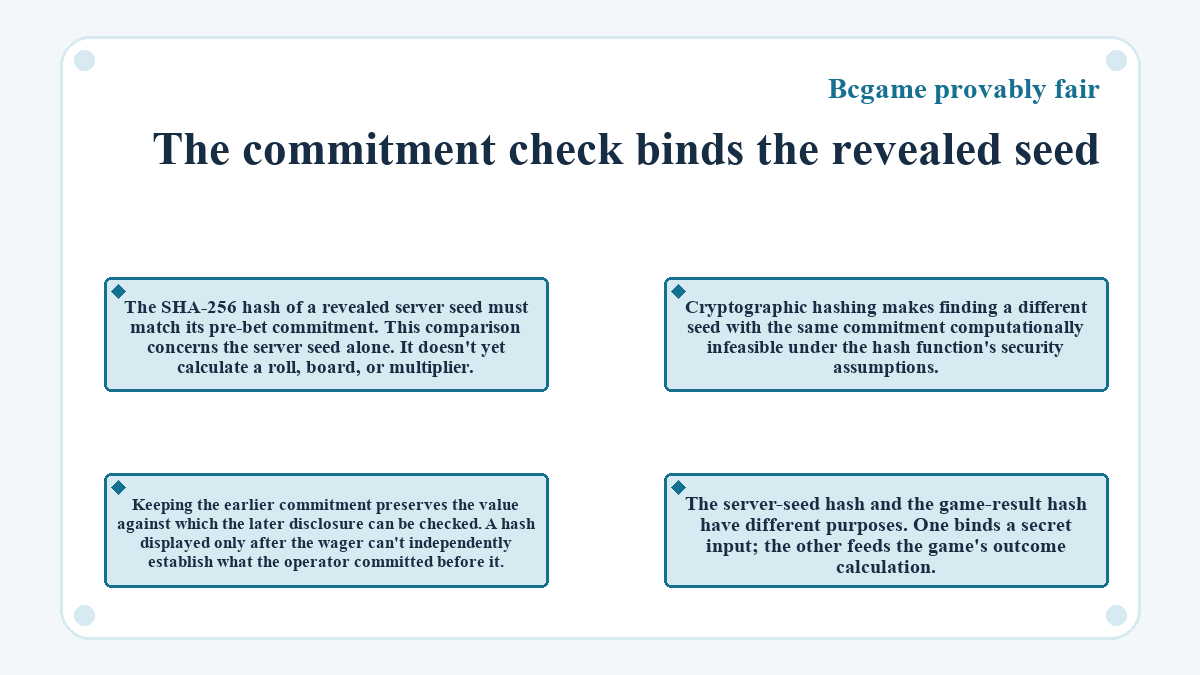
The server-seed hash and the game-result hash have different purposes. One binds a secret input; the other feeds the game's outcome calculation.
Game selection determines the result calculation
Classic Dice's published verifiers use HMAC-SHA256, with the server seed as the key. Their message joins the client seed and nonce with a colon. HMAC is a hash-based message authentication code. Separate implementations convert its output into the displayed roll differently, so the calculation must match the recorded bet's implementation. A checker using another conversion method can disagree even when it accepts the same seed fields.
Wheel interprets its generated number using the selected risk level, segment count, and applicable payout table. Those settings determine how a position maps to a multiplier. Its published verifier supports different payout configurations, so copying seeds alone doesn't identify the correct award. The game record's settings belong alongside the calculated position when comparing results. A matching intermediate hash leaves that final interpretation unchecked.
Mines generates an ordered list of board positions from its HMAC output. The published calculation uses additional hashing and sorting to produce that ordering. The selected mine count belongs in the board comparison, because it sets how many hidden mines the round contains. Comparing the reconstructed positions with the recorded board requires the original game settings.
Crash has a hash-chain verification method with inputs distinct from a personal seed-pair bet. Its published script accepts a game hash and uses the salt and result parameters applicable to that version. Hashing successive chain values checks their relationship, while a separate calculation derives the crash multiplier. Different historical salt settings make version selection material. A seed-pair checker for Dice doesn't reproduce this method merely because both games use cryptographic hashes.
Lottery verification includes a server seed and its hash, a stop block, a client-seed block, and a hashed client seed. Its complete dataset, including purchased-ticket information, becomes available after ticket sales stop. These draw-specific fields aren't interchangeable with an individual bet's nonce. A block reference must keep its role in the lottery calculation. Each draw therefore requires its own verification data and method.
Checking a settled bet without placing another wager
For a completed bet under a still-active seed pair, start with its saved pre-bet commitment and recorded inputs. An unrevealed server seed blocks the full calculation. Copy the available records before changing the active pair. Copying records and running calculations leave the settled wager unchanged; rotation replaces the active seed pair.
- If the server seed remains hidden, use the supported seed-change control to reveal it, or pause if you want to retain the active pair.
- Once the revealed seed is available, hash it and compare the digest with the saved commitment.
- If the commitment matches, select the verifier for the recorded game and algorithm version.
- Enter that bet's client seed, nonce, and required settings, then compare the reconstructed result with the recorded outcome.
- Check the same inputs with an independent implementation of the same game calculation.
Matching commitments and matching outcome calculations produce a reproducible check for the recorded bet. Neither verification nor seed rotation reverses its settlement.
What does a matching Bcgame result actually prove?
A matching result shows the disclosed inputs reproduce that recorded outcome under the selected calculation. Together with the earlier commitment check, it supports consistency between the committed seed and the result. A commitment match alone leaves the outcome conversion untested. The calculation also doesn't establish how the operator originally chose its secret or certify every other wager. Its scope remains the supplied record and algorithm; wider claims about statistical fairness require examination of the outcome mapping and probabilities.
Input and version differences explain different mismatch types
A commitment mismatch concerns the revealed seed and earlier hash. A result mismatch after a matching commitment concerns the remaining inputs or calculation.
Using a different seed pair for an older wager changes the material under examination. An incorrect nonce selects different calculation input, and a different game version can interpret the same digest differently. For Wheel, mismatched risk, segment, or payout settings can affect the displayed award. For Crash, a salt from another historical period can alter the calculated multiplier. Check the relevant field or method without changing unrelated parts of the record.
A missing field leaves the calculation incomplete. A reproducible disagreement with complete, correctly matched inputs remains an unresolved discrepancy. Keep the original record and calculation output intact instead of adjusting values until a checker reports agreement.
RTP and withdrawable balances remain separate questions
Return to player (RTP) describes the game's theoretical payout proportion across repeated wagers under its rules. The house edge expresses the corresponding statistical advantage to the operator. A verifiable random outcome can still follow a payout schedule with that advantage. Seed arithmetic checks consistency with a formula; it doesn't change the formula's probabilities or payouts. The applicable game information and payout configuration govern that separate question. An older percentage can't establish the rate applying to a different configuration or later wager.
Bonus cash-out rules and account security restrictions can affect withdrawals independently of game-result verification. A matching outcome doesn't show a balance is withdrawable.
Key questions about Bcgame provably fair
-
Can a Bcgame server-seed hash predict future results?
- A server-seed hash isn't a practical way to recover a sufficiently unpredictable secret seed. The commitment exposes a digest while keeping the underlying input hidden until reveal. Public hash data alone doesn't supply the secret needed for future-result calculations, and a client seed containing a supposedly lucky word doesn't provide that missing input.
-
Does changing letter case in a copied client seed affect verification?
- Changing letter case changes the client-seed input the verifier processes. Client seeds are strings, so capitals and lowercase letters represent different input characters. That change can affect the generated result even when the nonce stays identical. Preserve the recorded spelling and any characters belonging to the seed, including intentional spaces.
-
Is a wallet signature required to recalculate a Bcgame bet?
- Recalculating a recorded seed-based result doesn't require a crypto wallet signature. The published arithmetic uses the game's verification inputs, without authorizing a transfer. Wallet recovery phrases, private keys, and transaction approvals don't belong among those inputs. A checker asking for them introduces an unrelated request you can decline without losing the ability to calculate the result.
-
Can Bcgame seed verification run offline?
- A seed-based calculation can run offline once you have its required inputs and a complete implementation. The cryptographic arithmetic doesn't require a new wager or blockchain transaction. A web verifier may load its libraries from external servers, so saving its HTML alone doesn't necessarily preserve everything an offline copy needs.
-
What should I redact before sharing a Bcgame verification screenshot?
- Redact login credentials and unrelated account details before sharing a verification screenshot. Keep the game name, relevant settings, recorded outcome, and revealed verification inputs legible if someone needs to reproduce the calculation. A full account screenshot can also expose balances or identity details unrelated to the result you want checked.